Process assessment
Baseline the work as it runs today: variation, cycle time, quality criteria, failure modes.
Robotic inspection, deburring, grinding, and finishing on parts where the tolerance is tight and the process is already qualified.
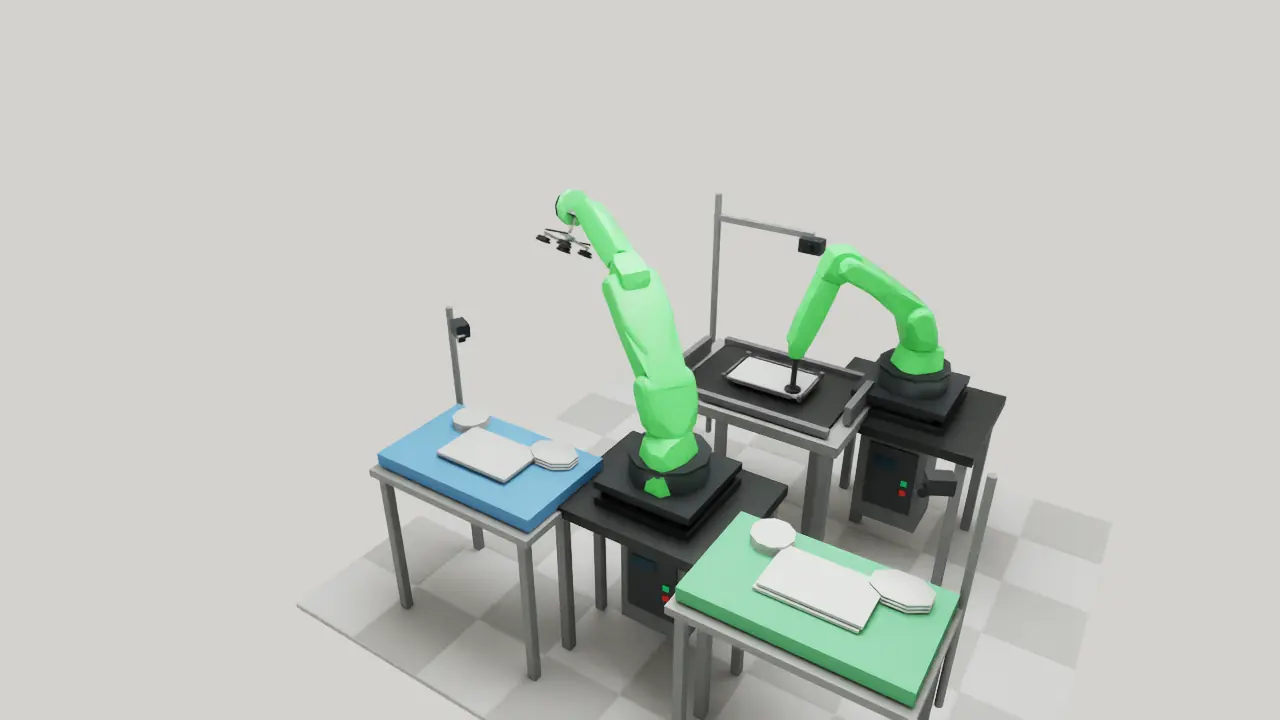
One process at a time, from first assessment to production handover.
Baseline the work as it runs today: variation, cycle time, quality criteria, failure modes.
Layout, fixturing, robot and sensor selection, on proven industrial hardware.
Vision and sensing that locates the part and reports how confident it is.
Trajectories from CAD, force control for contact-rich finishing.
Metrology against acceptance criteria, recorded run by run.
Operator training, change control, documentation for qualified processes.
A fixed, versioned sequence of steps. Not one model running the cell.
Sensors describe the part and the cell, with a confidence value attached.
The approved process definition decides the next step.
Each step uses what suits it: a model, a planner, a controller, or a person.
Tolerances, tool state, interlocks and revision pass, or the cell holds.
Measurements and decisions are stored together, run by run.
The process definition is separate from the equipment that carries it out. Swap a camera or a robot and you revalidate one step, not the process. Systems run at the edge, on the plant floor.

One program at a time, on purpose.
Our first program automates an FDA-approved process for a cardiovascular nitinol implant at a U.S. medical device manufacturer. The customer is confidential. A second precision manufacturing program is in scoping.
Precision and reliability figures are the customer's process requirements, not performance claims.
Send the part, the tolerance you need to hold, and the current cycle time. We will tell you if it fits.
hello@vihalabs.comVIHA, Inc.
Dallas-Fort Worth, Texas
Five engineers across robotics, perception, controls, and process engineering.